
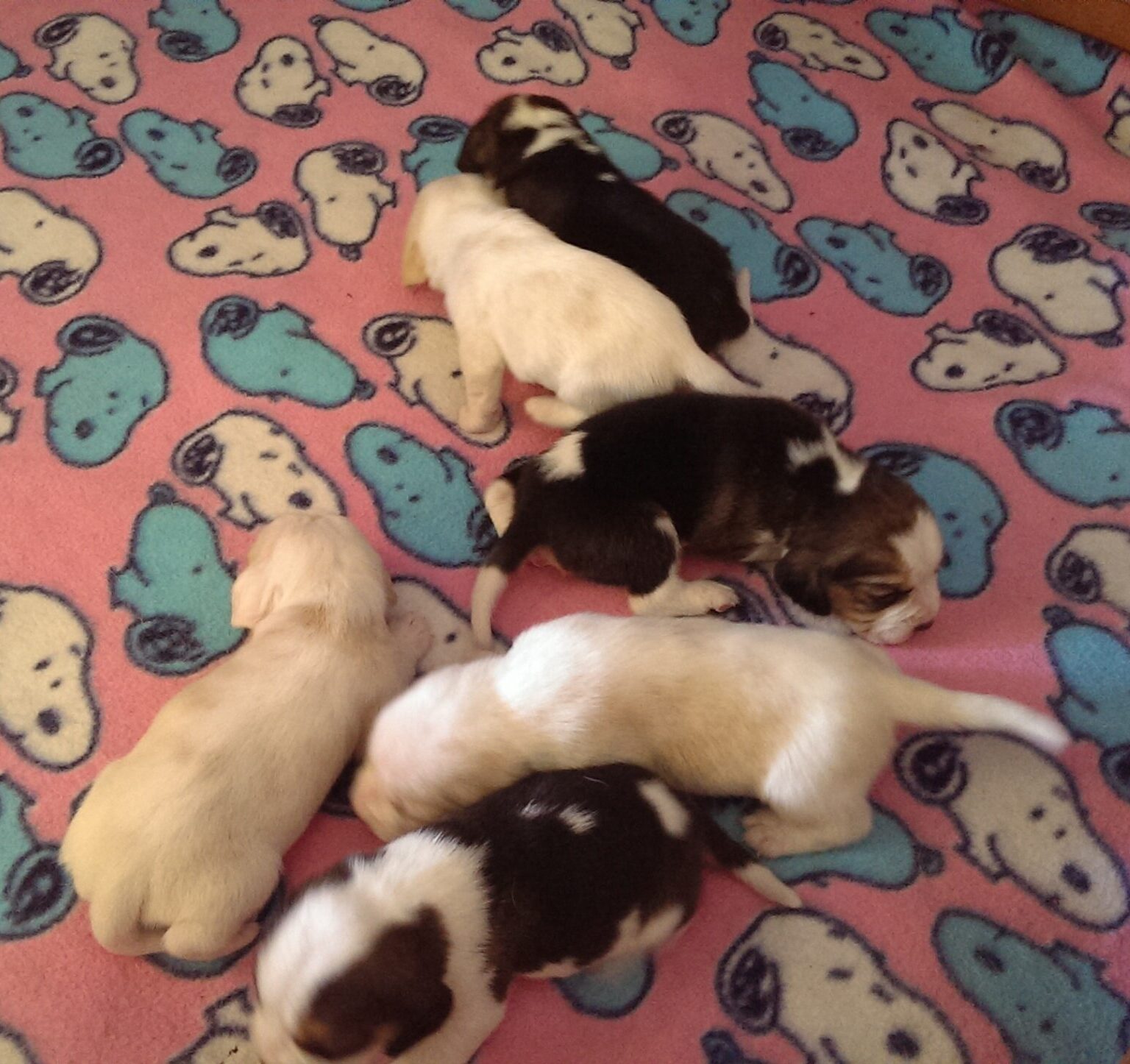
Neonatal Cerebellar Cortical Degeneration (NCCD), also known as cerebellar abiotrophy, is a rare but tragic inherited neurological disorder recognized in beagles and several other dog breeds. This disease leads to the progressive loss of nerve cells in the cerebellum—the part of the brain that coordinates movement and balance—resulting in noticeable and often severe movement problems at a very young age.
NCCD affects the Purkinje cells, which are large neurons located in the cerebellar cortex. These cells play a crucial role in regulating and smoothing out voluntary movements.
In beagles with NCCD, these Purkinje cells develop normally before birth but begin to degenerate shortly after birth. This degeneration leads to significant neurological deficits.
NCCD in beagles is inherited as an autosomal recessive trait, meaning puppies must inherit two copies of the defective gene—one from each parent—to be affected. Carriers (dogs with only one copy) do not show signs but can pass the gene on to their offspring.
Clinical Signs
The disease usually becomes evident in affected beagle puppies very early—typically when they begin to walk, at around 3 to 4 weeks of age. Common signs include:
- Severe uncoordinated movements (ataxia)
- A wide-based stance and difficulty standing
- Intention tremors: shaking that worsens when the puppy tries to move or reach for something
- Jerky or exaggerated steps (hypermetria)
- Frequent falling or rolling over
Unlike some other conditions, these puppies are typically alert and otherwise normal in behaviour and appetite. However, the severe movement disorder significantly affects their quality of life.
Progression and Prognosis
Sadly, NCCD is progressive. As more Purkinje cells degenerate, the coordination problems worsen. Puppies usually become unable to walk or feed themselves properly.
There is no cure or effective treatment, and affected puppies are often euthanized on humane grounds to prevent prolonged suffering.
Diagnosis
Diagnosis is typically based on:
- Age of onset and clinical signs: the very early appearance of ataxia and tremors.
- Breed history and family history: presence of the disease in related dogs.
- Genetic testing: a known mutation in the SEL1L gene has been identified as the cause of NCCD in beagles. Testing can confirm if a puppy is affected or if a breeding dog is a carrier.
- In some cases, post-mortem examination of the brain confirms the characteristic Purkinje cell loss.
Neonatal Cerebellar Cortical Degeneration in beagles is a heartbreaking disorder that affects puppies at the start of life, leading to severe coordination problems and often requiring euthanasia for humane reasons. Thanks to advances in genetic research, breeders can now identify carriers and prevent this disease, offering hope for healthier future generations of beagles.
References
Forman, O. P., De Risio, L., Stewart, J., Mellersh, C. S., & Beltran, E. (2012).
A novel SEL1L mutation leading to cerebellar cortical degeneration in the Beagle dog. PLoS ONE, 7(1), e30273.
– Key study identifying the mutation in the SEL1L gene as the cause of NCCD in beagles.
De Lahunta, A., & Glass, E. N. (2009).
Veterinary Neuroanatomy and Clinical Neurology (3rd ed.). Saunders Elsevier.
– Detailed description of cerebellar cortical degeneration, including breed-specific forms like in beagles.
Summers, B. A., Cummings, J. F., & de Lahunta, A. (1995).
Veterinary Neuropathology. Mosby-Year Book.
– Pathology textbook with discussion and images of Purkinje cell loss in affected beagle puppies.
Cummings, J. F., de Lahunta, A., & Summers, B. A. (1990).
Cerebellar cortical degeneration in the Beagle dog. Acta Neuropathologica, 80(2), 202–207.
– Classic pathology study describing the lesion patterns and onset in beagles.
Online Mendelian Inheritance in Animals (OMIA). (2025).
Cerebellar cortical degeneration in beagles. OMIA entry OMIA000173/9615.
– Lists the SEL1L mutation and inheritance pattern.
Tipold, A. (2010).
Inherited cerebellar diseases in dogs and cats. Veterinary Clinics of North America: Small Animal Practice, 40(1), 105–120.
– Review article covering multiple breeds, including neonatal form in beagles.
Penderis, J., & Schwarz, T. (2004).
Magnetic resonance imaging findings in two beagle puppies with neonatal cerebellar cortical degeneration. Journal of Small Animal Practice, 45(2), 104–107.
– Imaging study showing characteristic cerebellar changes in affected beagle puppies.
Mellersh, C. S., et al. (2013).
Genetic basis and DNA testing of inherited ataxias in dogs. Companion Animal, 18(4), 163–170.
– Discusses development and application of the genetic test for NCCD in beagles.