
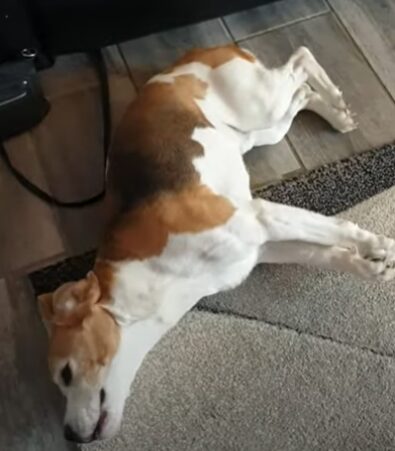
Lafora epilepsy, also called Lafora disease, is a rare inherited form of epilepsy that affects several dog breeds, including beagles. This neurological disorder is progressive, meaning it worsens over time, and it can significantly impact the quality of life of affected dogs.
What is Lafora Epilepsy?
Lafora epilepsy is a genetic disorder that causes dogs to develop epilepsy due to the accumulation of abnormal clumps of glycogen-like material known as Lafora bodies inside nerve cells and other tissues. These Lafora bodies disrupt normal cell function, particularly in the brain, leading to seizures and other neurological problems.
In beagles, Lafora disease is linked to a defect in the NHLRC1 gene, which is responsible for helping control how glycogen is stored in the body. When the gene doesn’t work properly, the abnormal storage leads to Lafora bodies.
Clinical Signs
Signs usually start to appear in middle-aged dogs, often between 5 and 7 years of age, though the exact age can vary.
Common signs include:
- Myoclonic seizures: brief, sudden jerks or twitches, often triggered by flashing lights, sudden noise, or movement.
- Generalized (tonic-clonic) seizures: full body seizures that may cause the dog to collapse and convulse.
- Disorientation and confusion after seizures.
- Changes in behavior, such as anxiety, pacing, or restlessness.
- Over time, dogs can develop dementia-like symptoms, including difficulty recognizing familiar places or people.
These signs typically worsen as the disease progresses, and the seizures may become more frequent or severe.
Treatment and Management
Sadly, there is no cure for Lafora epilepsy because it is a genetic and progressive disorder.
However, the condition can often be managed to improve a dog’s quality of life:
- Anti-seizure medications (such as levetiracetam or phenobarbital) may help control seizures.
- Environmental management, like reducing sudden flashing lights or startling noises, can help reduce myoclonic jerks.
- Regular monitoring and veterinary check-ups are essential as the disease advances.
Some dogs live several years with relatively good quality of life if the disease progresses slowly and seizures are managed well.
Breeding and Prevention
Because Lafora epilepsy is inherited as an autosomal recessive disease, both parents must be carriers of the mutated gene for a puppy to be affected.
Responsible breeders now often use DNA testing to identify carriers and affected dogs. By carefully planning matings (for example, never breeding two carriers), breeders can help prevent puppies from being born with Lafora disease.
Lafora epilepsy in beagles is a challenging, lifelong condition that can significantly affect dogs and their families. Thanks to genetic testing and greater awareness among breeders, it is now possible to reduce the risk of producing affected puppies. For dogs already diagnosed, thoughtful management and veterinary care can help them live more comfortably.
References
Lohi, H., Young, E. J., Fitzmaurice, S. N., Rusbridge, C., Chan, E. M., Vervoort, M., … & Minassian, B. A. (2005).
Expanded repeat in canine epilepsy. Science, 307(5706), 81.
– This landmark paper identified the dodecamer repeat expansion mutation in the NHLRC1 gene as the cause of Lafora disease in dogs, including beagles.
Lohi, H., et al. (2007).
Diagnosis of Lafora disease in dogs using NHLRC1 mutation testing. Veterinary Record, 161(11), 373–376.
– Discusses DNA testing to detect carriers and affected beagles.
Pumarola, M., Añor, S., Borràs, D., & Ferrer, I. (2010).
Canine Lafora disease: clinicopathological and immunohistochemical features in five cases. Journal of Comparative Pathology, 142(3), 203–211.
– Includes pathological description and diagnosis in affected beagles.
Rusbridge, C., & Knowler, S. P. (2013).
Inherited myoclonic epilepsies in dogs. Veterinary Journal, 195(2), 113–121.
– Reviews clinical signs, diagnosis, and management of Lafora disease in beagles and other breeds.
Saito, M., & Buckmaster, P. S. (2016).
Canine epilepsy: genetic causes and pathophysiology. Veterinary Clinics of North America: Small Animal Practice, 46(2), 243–256.
– Summarizes the genetic basis and clinical course in breeds including beagles.
Minassian, B. A. (2001).
Lafora’s disease: towards a clinical, pathologic, and molecular synthesis. Pediatric Neurology, 25(1), 21–29.
– Foundational paper; while focusing on humans, it laid groundwork for later studies on canine Lafora disease.
Online Mendelian Inheritance in Animals (OMIA). (2025).
Lafora disease in beagles. OMIA000630/9615
– Genetic database listing the known NHLRC1 mutation in beagles.
European College of Veterinary Neurology (ECVN).
Breed-specific recommendations for Lafora disease genetic testing in beagles (guideline summaries).
Fyfe, J. C., & Giger, U. (2007).
Inherited myoclonic epilepsies in dogs and cats. Veterinary Clinics of North America: Small Animal Practice, 37(3), 541–553.
– Includes a section discussing Lafora disease in beagles.