
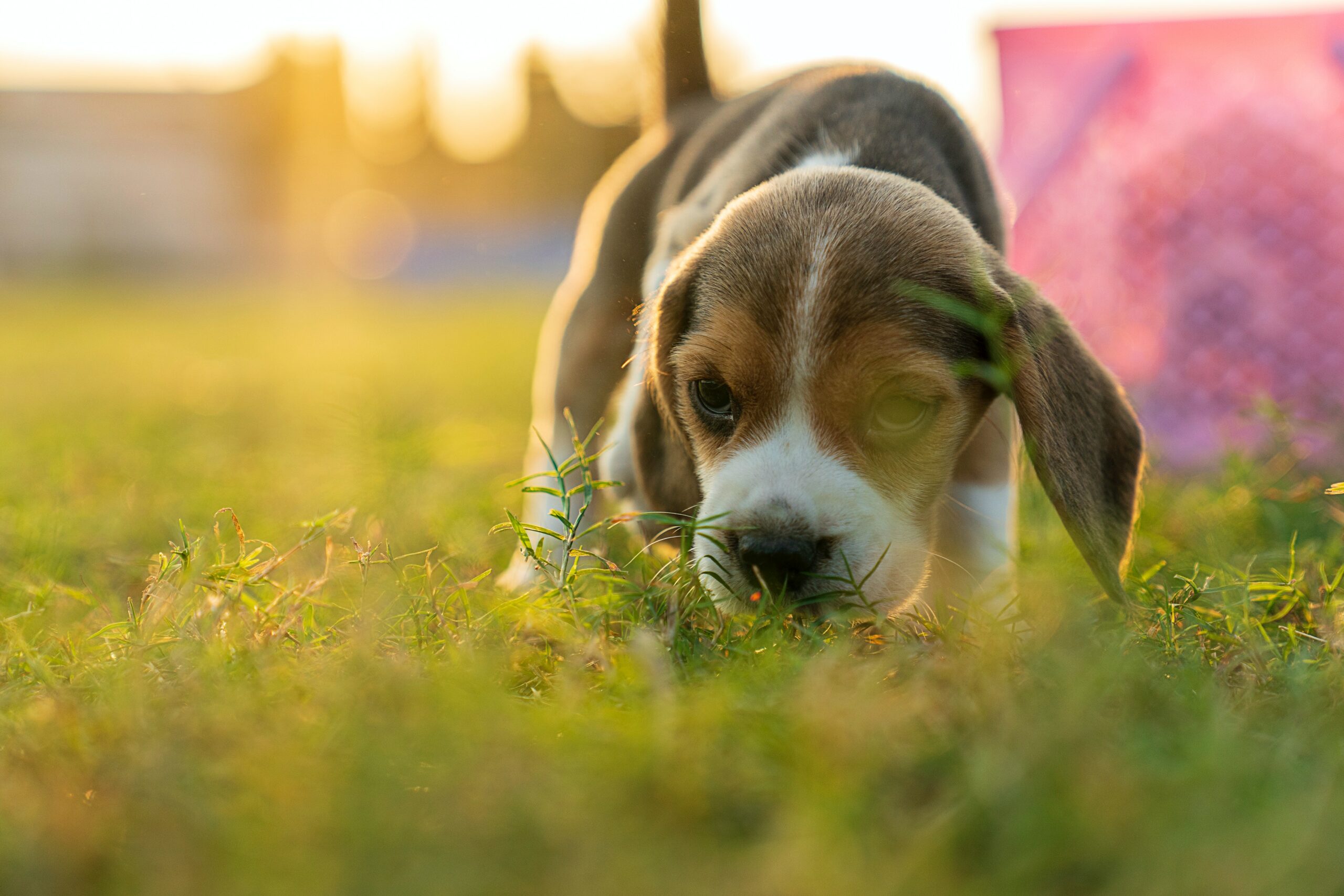
Congenital Stationary Night Blindness (CSNB) is a rare inherited eye condition that has been reported in Beagles, as well as in a few other dog breeds. As the name suggests, it is congenital, meaning dogs are born with it, and stationary, meaning it does not get worse over time. The main problem it causes is difficulty seeing in low light or darkness.
What is CSNB?
CSNB affects the retina, which is the layer of light-sensitive cells at the back of the eye. The retina has two main types of photoreceptor cells: rods and cones. Rod cells are especially important for vision in dim light. In dogs with CSNB, the rod cells do not function properly. This makes it hard for affected dogs to see in the dark, although their daytime vision usually remains normal.
How does it affect beagles?
Beagles with CSNB may seem hesitant to move around in poorly lit areas or may bump into things at night. Owners might notice their dog becomes nervous or clumsy when the lights are turned off or during evening walks. Since CSNB does not worsen over time, these dogs typically adjust to their condition and learn to rely on their other senses, like smell and hearing.
Importantly, CSNB does not cause pain or lead to complete blindness, and affected dogs can still enjoy a good quality of life. During the day, when light levels are higher, they can see almost as well as any other dog.
What causes CSNB in beagles?
CSNB in Beagles is inherited as a genetic disorder. Research has shown that it is usually passed on in an autosomal recessive pattern. This means that for a Beagle puppy to be affected, it must inherit two copies of the defective gene—one from each parent. Dogs that carry only one copy of the gene (carriers) do not show signs of the disease but can pass it on to their offspring.
Veterinary ophthalmologists can diagnose CSNB by performing an electroretinogram (ERG), a special test that measures the electrical responses of the retina to light. Dogs with CSNB show a distinctive ERG pattern due to the lack of rod function.
Living with a beagle with CSNB
If you have a Beagle diagnosed with CSNB, there are a few ways to help them cope:
Avoid sudden changes in your home’s layout, which can confuse the dog.
Use night lights in hallways and main rooms to help them navigate at night.
Try to walk your dog in daylight or well-lit areas.
Since CSNB is genetic, responsible breeding is important to reduce its occurrence. Breeders can work with veterinary geneticists to test their dogs and avoid breeding carriers together.
Although Congenital Stationary Night Blindness can sound worrying, most affected Beagles adapt very well. Their playful personalities and love for life aren’t diminished by not seeing well at night. With a bit of extra care and awareness, they can live just as happily as any other Beagle.
References
Kondo M. et al. (2015)
A Naturally Occurring Canine Model of Autosomal Recessive Congenital Stationary Night Blindness
- This landmark study describes clinical and electroretinographic features of Beagles with autosomal recessive, complete‐type CSNB. It confirmed normal daytime vision, absent rod ERG responses, and “negative‐type” mixed rod/cone ERGs—consistent with the Schubert‑Bornschein form of CSNB WIRED+15PLOS+15genomia.cz+15.
Kondo M. et al. (2013)
Canine Model of Autosomal Recessive Complete-type Congenital Stationary Night Blindness (ARVO abstract)
- Reports on pedigrees crossed with normal Beagles, confirming autosomal recessive inheritance and detailed ERG, morphological, and genetic analyses in CSNB‐affected Beagles IOVS.
Oh A. et al. (2017)
Detailed phenotypic characterization of a Beagle dog with the complete form of Schubert‑Bornschein CSNB (ARVO abstract, IOVS 58:286)
- Offers a comprehensive clinical evaluation—including OCT imaging, behavioral navigation tests, and full‐field ERG—of a Beagle with complete CSNB, showing delayed dark adaptation and negative ERG responses SpringerLink+5IOVS+5ResearchGate+5.
Foster M. L., Mowat F. M. et al. (2018)
Phenotypic characterization of complete CSNB in the inbred research beagle: how common is CSNB in research and companion dogs? (Documenta Ophthalmologica, 137:87–101)
- Provides detailed ERG data from an affected Beagle and examines prevalence among inbred and outbred Beagle populations, finding CSNB to be rare but present in research colonies genomia.cz+11SpringerLink+11PLOS+11.
Das G. R. et al. (2019)
Genome‑wide association study and whole‑genome sequencing identify a deletion in LRIT3 associated with canine congenital stationary night blindness (Scientific Reports, 9:14166)
- Defines the molecular basis of CSNB in Beagles—a 1 bp deletion in the LRIT3 gene—using GWAS and WGS, confirming a practical DNA test for breeding CombiBreed+3omia.org+3IOVS+3SpringerLink+15genomia.cz+15AlphaDog DNA+15.